I want to be a teacher. What do I need to know?

Pretty much teaching is more than just teaching. I can give you a rather long list of what teachers do on a daily basis from educator to social worker, from nurse to psychologist and beyond. That aside let’s focus this post on the qualities and special skills that teachers need to bring.

Let’s begin with fostering a positive learning environment. I’ve written about positive classrooms before, but essentially it is about making everyone feel safe and secure as a person and a learner. How might we foster such an ambience in our classrooms and out? Learning their names is a great start, as well as knowing something about them, their likes, dislikes, favourite team, favourite game, favourite person. Always having a smile and ‘how are you today?’ ready to go, and meaning it, every time is great too. To be a teacher you have to love kids, AND love learning. A love of learning is contagious and will soon have them running to your class. 

Next, there has to be an understanding of child development. Being au fait with some of the theories is useful, but only if you can put it into practice, for your students. This will vary depending on your students; who they are, where they are, how old they are. For example, there’s Piaget’s Theory of Cognitive Development, in contrast we have Vygotsky’s Theory of Cognitive Development in Social Relationships and then there’s the 8 Stages of Development by Erik Erikson. There are many more, of course, but I’ll leave that to you to investigate further. 

Further, there are the all important students’ learning preferences and how to coordinate and differentiate the learning. What kinds of teaching and learning strategies will you use? What’s worked before? What hasn’t? Why? Further, teachers need to have subject matter expertise which varies depending on whether you are in early childhood, primary or secondary schools.You’ve probably heard someone, sometime say, ‘primary teachers teach children, secondary school teachers teach subjects’ – NOPE! NOT TRUE! We ALL teach children, some of us also teach adults. Yes, we need to have subject expertise but we also need to be open to learning about everything but most especially learning your students. It’s not always about the content.

Finally, strong communication skills are a must as is effective classroom management. I don’t just mean keeping them in line but rather, back to my first point, fostering a positive learning environment, knowing our students, empathising with them, communicating and understanding their needs. Theories are great, but practice is better. 

Jo Prestia

Believe this and teaching will be much more engaging and rewarding.

What else do you think we should know? Please comment below, share your thoughts. 

Thanks for reading 🙂

Who’s your awesome teacher?

VeniceAsk any teacher why they became one and the most common response is that they once had an awesome teacher that made them want to become an educator themselves. Mine was Zacher a wonderful art teacher who made me want to learn about how art came about, about the Egyptians, the Greeks and the Romans and romanesque and gothic and renaissance and baroque and then some. I can still see clearly in my mind the wonderful notebooks she put together and the very special times we spent huddled around the art tables going through the history as she told stories of what had happened and invited us to contribute, to question and to seek our own responses. I still have my essays, hand written on foolscap lined paper. More importantly, I never forgot those learning sessions and to this day I teach, I learn and I question. I also make art – not in any common studio form such as painting and ceramics like I did in university but I think and do art works – differently. I have a collection of diaries, for examples, one each for my adventures overseas. In them I poured out my thoughts and feelings, I described my adventures, I drew and I tore paper and images and pasted them in. Then I drew over the top and even used water colour pencils something I had dismissed due to my experiences in that same university. You see I don’t particularly like rules, nor do I think that there are always ‘right’ answers. I approach everything through a visual, emotional perspective. Some might say that that is why I get into trouble! And that’s true I get emotionally attached and then it hurts when things don’t work out. At the same time that’s okay too, because I like capturing those moments when you’re suddenly struck by a new thought and take the risk regardless.

As an educator, I value uppermost the importance of relationships. I suspect that the teachers mentioned by my colleagueArt educators have this gift to connect with their students in many ways. These are the teachers that become the ‘awesomes’. They seem to be always the ones that make the effort, that give a damn about how and who you really are. They’re not superficial, they really do want to know. They are also the same ones who do everything in their power and then some, to allow you to succeed. They take opportunities to connect with you. They seek your learning preference and find out what you like and then they ingeniously combine and blend, mingle, amalgamate, and intermix them strategically within the content to get you hooked – all of us – hooked into learning.

So, if you get one message from this post it’s that tomorrow when you get to school you make an extra effort to connect with that kid who always gets away. I recommend 5 simple things to get you started:

1. Make eye contact and smile 🙂

2. Greet them individually by name

3. Notice something they do well and let them know about it

4. Tell them what you like to do and why.

5. Ask them what they like to do and why.

I’d love to hear what you do to form your learning relationships with students.

Thanks for reading 🙂

My favourite teacher

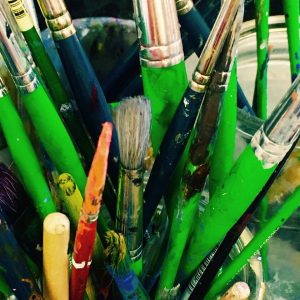
Paintbrushes

Let me take you back to your classroom experiences. Can you recall your favourite teacher, what was it about them that you liked? How did they engage you in learning? Did they use visuals, play videos, talk, write on the board, have you working in groups, ask questions, present learning in many forms? Did they know you – I mean really know you, not just your name, but your thoughts and feelings about school, about life, what you liked, didn’t like – did they?

I know mine did – her name was Zacher, she was the teacher on whom I most model myself. She made the pages of my art text book come alive. She would tell stories about the people who made the works. She was very passionate about her subject and we couldn’t help but join her in the adventures of the ancient Egyptians, the Greeks, the Romans and especially the most famous of all – those from the Renaissance, Leonardo, Michelangelo, Raphael and Donatello! Are these names familiar? You might remember them as the Teenage Mutant Ninja Turtles!

Zacher was the reason I became an art teacher. I made up my mind in Year 9 and I never looked back. Thirty something years later my love of teaching and learning has not spent.

Thanks for reading 🙂