I want to be a teacher. What do I need to know?

Pretty much teaching is more than just teaching. I can give you a rather long list of what teachers do on a daily basis from educator to social worker, from nurse to psychologist and beyond. That aside let’s focus this post on the qualities and special skills that teachers need to bring.

Let’s begin with fostering a positive learning environment. I’ve written about positive classrooms before, but essentially it is about making everyone feel safe and secure as a person and a learner. How might we foster such an ambience in our classrooms and out? Learning their names is a great start, as well as knowing something about them, their likes, dislikes, favourite team, favourite game, favourite person. Always having a smile and ‘how are you today?’ ready to go, and meaning it, every time is great too. To be a teacher you have to love kids, AND love learning. A love of learning is contagious and will soon have them running to your class. 

Next, there has to be an understanding of child development. Being au fait with some of the theories is useful, but only if you can put it into practice, for your students. This will vary depending on your students; who they are, where they are, how old they are. For example, there’s Piaget’s Theory of Cognitive Development, in contrast we have Vygotsky’s Theory of Cognitive Development in Social Relationships and then there’s the 8 Stages of Development by Erik Erikson. There are many more, of course, but I’ll leave that to you to investigate further. 

Further, there are the all important students’ learning preferences and how to coordinate and differentiate the learning. What kinds of teaching and learning strategies will you use? What’s worked before? What hasn’t? Why? Further, teachers need to have subject matter expertise which varies depending on whether you are in early childhood, primary or secondary schools.You’ve probably heard someone, sometime say, ‘primary teachers teach children, secondary school teachers teach subjects’ – NOPE! NOT TRUE! We ALL teach children, some of us also teach adults. Yes, we need to have subject expertise but we also need to be open to learning about everything but most especially learning your students. It’s not always about the content.

Finally, strong communication skills are a must as is effective classroom management. I don’t just mean keeping them in line but rather, back to my first point, fostering a positive learning environment, knowing our students, empathising with them, communicating and understanding their needs. Theories are great, but practice is better. 

Jo Prestia

Believe this and teaching will be much more engaging and rewarding.

What else do you think we should know? Please comment below, share your thoughts. 

Thanks for reading 🙂

The power of Acrostic Poems

Letters

An acrostic poem is a composition where the first letter on each line spells out a related word or phrase. You are probably familiar with acrostic poems in relation to names using adjectives to describe the person. My kids sometimes compose them for me on special occasions such as Mothers’ Day,

aMazing

lOving

Tenacious

Happy

Extraordinary

Radiant

MOTHER

Acrostic poems can also be used as a learning tool. For example, let’s take the word LEARNING. Place each letter on a separate line;

L

E

A

R

N

I

N

G

Then, each letter becomes the first letter of your word or phrase to do with learning. Hence,

Literacy

Engaging

Academic

Reading

New experiences

Improvement

Numeracy

Grasp

An acrostic poem can also take other forms. Some allow the first letter to come anywhere along the word (as in MOTHER above) or line, for example, 

This school has improved the LITERACY skills of its students by exposing them to a wide range of age appropriate books.

While acceptable, I much rather the challenge of leaving the letter as the first of each word or phrase.

I enjoy challenging my students to compose more detailed acrostics although this task is easily differentiated to suit the learning needs of individual students, with a little added challenge.

I find they are a great way to introduce letters and words.

A is for APPLE… (remember all words must relate)

Apple juice

Peel

Pink ladies

Lunch

Eat

Challenge them to write or say whole sentences;

Apple juice tastes better when the

Peel is removed before juicing.

Pink ladies are my favourite fruit to eat for

Lunch, although I also like to

Eat granny smiths, but only in my grandma’s apple pie!

It can be quite a challenging task for older students, easily incorporated into the learning or used as a revision tool.

For example, last week’s topic in my Foundations class was Social Theories. Here’s one I prepared earlier (hehe)

Acrostic Poem – Social Theory

Why not have a go yourself or challenge your students. Acrostics poems do not have to rhyme, but hey, that’s an added challenge if they’re up for it. The words and phrases can stand alone or create a running commentary. Be creative! I would love for you to share some of the compositions or ideas you come up with.

Thanks for reading 🙂 


Aspire Day – my first face to face in 2 years

Back to school

This week I nervously fronted up for my first face to face experience in over two years. It was a session with approximately 100 Year 11 students who were taking part in what the school called Aspire Day. My task was to inspire them into thinking about where they want to be and what steps they might take to get there. Students have been in lockdown for the best part of two years, dealing with issues at home, with their own sense of wellbeing while also trying to keep up their education via online learning. That meant no practical classes as such, no experiments, except perhaps watching you tube videos, no physical education classes, no team sports and definitely very little time spent in person with their mates or other family members aside from those they live with.

So too did teachers.

Since returning to onsite learning this year, many schools have continued and even bolstered activities to do with wellbeing for both students and teachers. Aspire day at this particular school was one such way to bring students and their homeroom teachers together to celebrate, reflect and plan for the future. 

2022

While I was nervous for the first few minutes, once I got into it, well, it’s like riding a bike as they say. I so enjoyed being with the students, moving around the auditorium (at a distance of course). It almost felt a little unreal. So many faces looking at you directly, at least for the most part. At times some of them would close their eyes, flop down into their chair, become distracted around their mates, but hey, so would I after so long in front of a screen. It didn’t bother me as I had most of them in my sights, lots of nodding and smiling and recognition amongst the 100 strong crowd. Some even giggled at my jokes every now and then and raised their hands to respond to questions I asked. And, just because their eyes were resting, didn’t necessarily mean they were not listening. I’m an optimist after all. Plus, I asked them how they were feeling and they did say they were tired. All good.


Year 11 responses

I also asked them where they see themselves in five years’ time. This is a tough question for many of us, let alone a bunch of very tired 16-17 year olds. Still, it was interesting to read their responses. Among one or two, ‘no idea’ responses we did see some very positive forward thinking: ‘successful’ (whatever that means), ‘builder’, ‘owning my own business’, ‘university’, ‘business marketing’, ‘having a full time job’, ‘rich’ to list a few. My favourite was ‘in New York’! Along with these, there were also a few concerning responses. Not surprising but worth following up by their teachers. I won’t share these here.

That said, I was reassured that after what we have all been through, and will continue to experience, our students are a shining light. They have dreams and hopes. We never gave up on them and all that hard work trying to keep them on track has and will continue to pay off. After all that’s why we teach, yes?

I so enjoyed the session and am looking forward to many more opportunities to visit schools and work with both staff and students. 

Thanks for reading 🙂

What is teaching ready?

Over the last few weeks I’ve been marking Teaching Performance Assessments (TPA) submitted by my 4th year pre-service teachers (PSTs). I have to say nothing in marking has given me more pleasure than reading and assessing PART 1 where they share their context, student group, lesson plans and mentor feedback, and write about their experiences on placement, and what this may mean for their future learning. In a few weeks this latest group of PSTs will complete their studies and hopefully most of them will be out there making a difference to children’s lives.

Every TPA I read was unique, every student had their own way to present and every subject & topic was different. I was enthralled with some of the strategies they used to engage the students from primary, secondary, international, and special schools. This cohort of PSTs are what the Chief Examiner calls ‘bipedagogical.’ They have experienced both face to face and online teaching (no need to explain why). They have experienced the same trials and tribulations as many of my colleagues, moving from one to the other sometimes within hours due to sudden lockdowns. It got me thinking…

The ‘bipedagogical’ teacher

What does it mean to be teaching ready?

Lots and lots and lots of hard work.

Today, it’s not just about the subject or unit you’re teaching. Expertise in these areas is, of course, important but before you get to share this, it is imperative to establish a safe and secure learning environment where you can build relationships with students and understand the contexts from which they come. I’ve shared some ideas about building relationships before here and here. My PSTs on the whole recognised how context affects learning. It means you need to prepare and cater for a diverse range of learners, your learners, in this classroom or in this learning space. It’s pretty daunting coming into an online space with a group of students you’ve never met before from a school you may or may not have visited in person and work with a mentor whom you’ve only recently met.

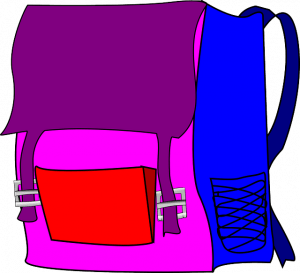
I often mention to my PSTs that they need to always be carrying a great big bag around (metaphorically of course – as we teachers know, we already have enough ‘stuff’ to cart around), which they can fill with strategies for teaching, learning and reflecting. Every time they see, hear, feel and think of an idea they can use in teaching and learning, they have a place right there into which they store it for that off chance they just might need it in the future. And they will. Even I bagged a few new ones for myself as I was reading through their TPAs. 

The strategy bag

Though these strategies might already be in that bag, somewhere, I might not have used them in a while, or it might be that my PSTs thought about it differently or presented it more creatively than I have thought to do. 

I wanted to share just two that I really liked. 

The first is around questioning for feedback. Think about how you ask your students if they had enough time to finish their task and the connotation that has on them as a learner. “Have YOU had enough time? This type of question might make them feel inadequate or slow if they haven’t completed the task. But what if we turned the question on its head? 

“Have I given you enough time?” What does this question say to our learners now?

The second strategy is an ICT tool called ‘Pear Deck’. Have you heard of it? I hadn’t but it sounded good, so I looked it up. The tech allows you to turn presentation slides like PPTs into interactive activities for your students or anyone else for that matter, so they can actively engage with the learning. Here are 20 ways to use it. My PST used it in his Year 10 English class to have students work as a group or individually at their own pace, responding to questions. Their responses come to your screen where you can give immediate feedback, and can also be shared anonymously on the slide projector for the whole class to discuss.

So, what is teaching ready? Well, for me there’s a list;

  • it’s building relationships,
  • being reflective
  • understanding context,
  • learning how students engage,
  • having expertise in your teaching areas,
  • planning explicitly for teaching and learning
  • understanding how to give and receive feedback for learning,
  • be willing to learn things yourself and …
  • loving it all!

Thanks for reading 🙂


Day 10: Berlin – the process of coming to terms with your own history.

Let’s wrap this up eh?

Shall we do Berlin today?

I think so.

Travelling from Verona, via Munich, we arrive at Berlin TX on the 8th July, 2016. From there a bus and train ride to Alexanderplatz, the centre of East Berlin where we were greeted by a summer downpour ☔️ which lasted only as long as it took to run into a convenience store to buy an umbrella! We stayed at the Park Inn overlooking the plaza where there was a wine and food festival happening. We ate and drank very well that week!

Our interest in WW1 and the Western Front was covered in a couple of posts earlier here and here, but we are also very much interested in all things WW2. While in Berlin we booked multiple walking tours to find out as much as possible about Berlin, and about the Holocaust. We were not disappointed. I highly recommend these walking tours. We used Insider Tours but there are many others. 

Berlin Wall, My journal, 2016

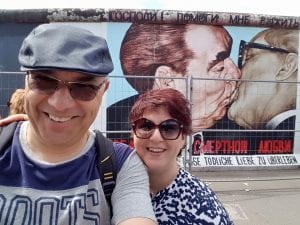
At the wall, 2016

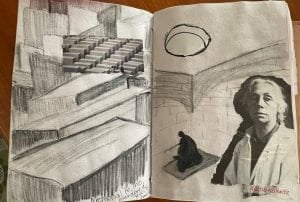
It has not always been pretty for Germany. Memorials to those times are prevalent all over Germany, the Topography of Terror, is one that bears witness to these. Germany is the only place that is ‘working through a process of coming to terms with its own history’ still. Kollwitz’s Pieta’ (AKA ‘Mother with her dead son’) provides the focal point within a monochromatic room behind the columns of the Neue Wache building, otherwise sparse, the open sky peeks through the circular opening directly above it. The eerie Memorial to the murdered Jews of Europe, consisting of 2711 grey slabs ranging in height from 20cm to just over 4.5 metres. As you walk through you are engulfed in the grey, you feel lost and alone and melancholic. You just want to run, run, run, to escape, but where is out??? Is it enough to dedicate such a memorial? Will anything we do be enough? 

Memorials of the Holocaust – My journal 2016

Hitler’s bunker now filled with concrete and covered by a dirty, unkept carpark surrounded by public housing  – is that enough? Visiting the many concentration camps, not only in Germany but in many other places, to remember, to pray, to weep. For those who have visited them you know there is not much to say. You arrive with angst and anticipation, courageous even, and while you think you’re ready – you are most definitely not. I wasn’t. I was overcome even more so than at the Western Front. I could hear their screams in the silence. I could hear their silence.

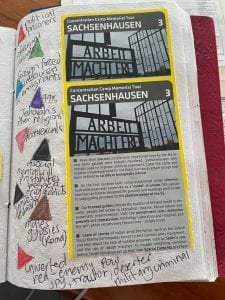
Sachsenhausen Concentration camp

Nothing prepares you. It is after these particular experiences that my journals save me. Once I get back and even sometimes on the way home to our hotels, my journals are where I put my emotions. I tear paper, sections from brochures, I scribble and draw, scratch and write down things I heard said, feelings I felt and memories I must never forget. It calms me. Then I can sleep and be prepared for the next day. Without my journals I am spent.

It is only then that I can find sanity in amongst all the madness.

Museum Island, Berlin – Queen Nefertiti (c. 1340BCE)

After the madness

It was after one of these walking tours that we decided to spend some time on Museum Island. There were two specific exhibits I needed to see with my own eyes. Queen Nefertiti, ‘the beautiful one has come’, stands in the centre of the room at the Neues Museum, surrounded by glass and visible down the centre of a series of open doorways. I fell in love with her. 

The second was the Ishtar Gate, I mentioned in an earlier post. “Simply stunning” is all I wrote next to an image in my journal. I was obviously overwhelmed at its impact. You certainly are dwarfed and to be able to walk right up to it and view its detailed stone work was worth it. It was getting very late and they were closing but I was happy to have seen these most wonderful pieces of history.

Last drinks in Berlin, My journal, 2016 – Cheers!

And so it ends

Alas our 10-day holiday journal adventure has come to an end. Without my journals, my travels would be a litany of endless photographs of people and selfies, artworks and architecture, streets and villas, monuments and landmarks. Pictures and photographs are worth 1000 words. They can be interpreted and discussed, and prompt the most wonderful of stories. Using visuals is a wonderful creative process that I use constantly in my teaching, but the journals are a culmination of the emotions experienced; nothing could replace them. 

Thank you for reading my holiday posts and a special mention to those who took the time to engage with comments and clicks. I do hope you enjoyed the travels. I know I took great pleasure in traveling through my journals again, especially in this time of uncertainty. Perhaps I could do it again some time soon. I have many things I did not share. Some I never will, but still…

Thanks for reading 🙂