I want to be a teacher. What do I need to know?

Pretty much teaching is more than just teaching. I can give you a rather long list of what teachers do on a daily basis from educator to social worker, from nurse to psychologist and beyond. That aside let’s focus this post on the qualities and special skills that teachers need to bring.

Let’s begin with fostering a positive learning environment. I’ve written about positive classrooms before, but essentially it is about making everyone feel safe and secure as a person and a learner. How might we foster such an ambience in our classrooms and out? Learning their names is a great start, as well as knowing something about them, their likes, dislikes, favourite team, favourite game, favourite person. Always having a smile and ‘how are you today?’ ready to go, and meaning it, every time is great too. To be a teacher you have to love kids, AND love learning. A love of learning is contagious and will soon have them running to your class. 

Next, there has to be an understanding of child development. Being au fait with some of the theories is useful, but only if you can put it into practice, for your students. This will vary depending on your students; who they are, where they are, how old they are. For example, there’s Piaget’s Theory of Cognitive Development, in contrast we have Vygotsky’s Theory of Cognitive Development in Social Relationships and then there’s the 8 Stages of Development by Erik Erikson. There are many more, of course, but I’ll leave that to you to investigate further. 

Further, there are the all important students’ learning preferences and how to coordinate and differentiate the learning. What kinds of teaching and learning strategies will you use? What’s worked before? What hasn’t? Why? Further, teachers need to have subject matter expertise which varies depending on whether you are in early childhood, primary or secondary schools.You’ve probably heard someone, sometime say, ‘primary teachers teach children, secondary school teachers teach subjects’ – NOPE! NOT TRUE! We ALL teach children, some of us also teach adults. Yes, we need to have subject expertise but we also need to be open to learning about everything but most especially learning your students. It’s not always about the content.

Finally, strong communication skills are a must as is effective classroom management. I don’t just mean keeping them in line but rather, back to my first point, fostering a positive learning environment, knowing our students, empathising with them, communicating and understanding their needs. Theories are great, but practice is better. 

Jo Prestia

Believe this and teaching will be much more engaging and rewarding.

What else do you think we should know? Please comment below, share your thoughts. 

Thanks for reading 🙂

Dear Parents/Guardians, Welcome to the VCE!

Welcome to VCE, the two most important years in the life of your child. In many ways I think it’s such a pity that they remain such a make or break part of an adolescent’s secondary education – but until attitudes change and the powers recognise that our children could be so much more if we were not all subjected to the same test, on the same day, at the same hour and all just to get a number which isn’t even out of a nice round number like say…100. No, the highest ATAR score any child can achieve is 99.95. All well and good. BUT this number or ranking has a massive lead into period, only to be valid for just a short time while universities get their acts together and make an offer. After that the rating is invalid – no one really ever asks again, do they? Then there are other students who work their way through an equivalent course so as to gain a VPC certificate. They don’t sit VCE exams and therefore do not gain an ATAR score. They go onto apprenticeships and/or TAFE courses. Some students add in VET combinations that can enhance both VCE and VCAL courses. A number of Victorian secondary schools also offer their students the BaccalaureateAll are invaluable experiences that I hope the students appreciate and take full advantage.

This is all great news but what I really want to focus on in this post is what you as parents or guardians can do to assist and support your children as they enter and complete their last two years of secondary education with an emphasis on VCE/VET certificates leading to an ATAR score.

Make an effort to eat dinner together as a family unit where possible. This will give you an opportunity to ask about their day but don’t just ask how their day was, be more precise. For example, ask them what they enjoyed about school today, what was their ‘ah ha’ moment, what challenged them, what surprised them.

Encourage them to share their learning with you. This can be done while you’re cooking or walking the dog. My eldest would read her essays aloud to me while I was preparing dinner. It helped her grasp her thinking and attend to any errors. I didn’t even have to say anything. If you think they could improve, ask them to tell you more about this or that – this will help them articulate their thinking and be more insightful.

You might like to read their English or Literature text so you can prompt them or at least know what they’re discussing in those essays.

If they are unsure, have questions, or don’t seem to grasp the concepts, encourage them to seek assistance from their teachers, if not that, remind them that there are other teachers who also teach the same subject. They might have someone else they trust.

Remind them that there is more to life than that ATAR score. The final years of secondary education should have balance. You’ve heard it all before, make sure they are getting enough sleep, eat well, interact with friends and family, do things they enjoy, watch a movie, go to dinner or a concert, work part-time – balance is key here.

Don’t pressure them, let them know you’re there, communicate, love, encourage and celebrate. Oh, and get them to write often, with a pen! You’ll thank me later!

All the best.

Thanks for reading 🙂

The power of Acrostic Poems

Letters

An acrostic poem is a composition where the first letter on each line spells out a related word or phrase. You are probably familiar with acrostic poems in relation to names using adjectives to describe the person. My kids sometimes compose them for me on special occasions such as Mothers’ Day,

aMazing

lOving

Tenacious

Happy

Extraordinary

Radiant

MOTHER

Acrostic poems can also be used as a learning tool. For example, let’s take the word LEARNING. Place each letter on a separate line;

L

E

A

R

N

I

N

G

Then, each letter becomes the first letter of your word or phrase to do with learning. Hence,

Literacy

Engaging

Academic

Reading

New experiences

Improvement

Numeracy

Grasp

An acrostic poem can also take other forms. Some allow the first letter to come anywhere along the word (as in MOTHER above) or line, for example, 

This school has improved the LITERACY skills of its students by exposing them to a wide range of age appropriate books.

While acceptable, I much rather the challenge of leaving the letter as the first of each word or phrase.

I enjoy challenging my students to compose more detailed acrostics although this task is easily differentiated to suit the learning needs of individual students, with a little added challenge.

I find they are a great way to introduce letters and words.

A is for APPLE… (remember all words must relate)

Apple juice

Peel

Pink ladies

Lunch

Eat

Challenge them to write or say whole sentences;

Apple juice tastes better when the

Peel is removed before juicing.

Pink ladies are my favourite fruit to eat for

Lunch, although I also like to

Eat granny smiths, but only in my grandma’s apple pie!

It can be quite a challenging task for older students, easily incorporated into the learning or used as a revision tool.

For example, last week’s topic in my Foundations class was Social Theories. Here’s one I prepared earlier (hehe)
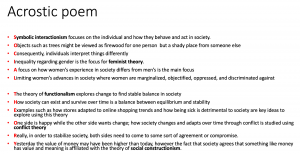
Acrostic Poem – Social Theory

Why not have a go yourself or challenge your students. Acrostics poems do not have to rhyme, but hey, that’s an added challenge if they’re up for it. The words and phrases can stand alone or create a running commentary. Be creative! I would love for you to share some of the compositions or ideas you come up with.

Thanks for reading 🙂 

 

Aspire Day – my first face to face in 2 years

Back to school

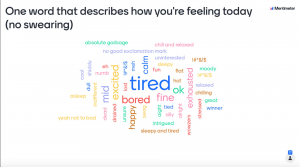
This week I nervously fronted up for my first face to face experience in over two years. It was a session with approximately 100 Year 11 students who were taking part in what the school called Aspire Day. My task was to inspire them into thinking about where they want to be and what steps they might take to get there. Students have been in lockdown for the best part of two years, dealing with issues at home, with their own sense of wellbeing while also trying to keep up their education via online learning. That meant no practical classes as such, no experiments, except perhaps watching you tube videos, no physical education classes, no team sports and definitely very little time spent in person with their mates or other family members aside from those they live with.

So too did teachers.

Since returning to onsite learning this year, many schools have continued and even bolstered activities to do with wellbeing for both students and teachers. Aspire day at this particular school was one such way to bring students and their homeroom teachers together to celebrate, reflect and plan for the future. 

2022

While I was nervous for the first few minutes, once I got into it, well, it’s like riding a bike as they say. I so enjoyed being with the students, moving around the auditorium (at a distance of course). It almost felt a little unreal. So many faces looking at you directly, at least for the most part. At times some of them would close their eyes, flop down into their chair, become distracted around their mates, but hey, so would I after so long in front of a screen. It didn’t bother me as I had most of them in my sights, lots of nodding and smiling and recognition amongst the 100 strong crowd. Some even giggled at my jokes every now and then and raised their hands to respond to questions I asked. And, just because their eyes were resting, didn’t necessarily mean they were not listening. I’m an optimist after all. Plus, I asked them how they were feeling and they did say they were tired. All good.


Year 11 responses

I also asked them where they see themselves in five years’ time. This is a tough question for many of us, let alone a bunch of very tired 16-17 year olds. Still, it was interesting to read their responses. Among one or two, ‘no idea’ responses we did see some very positive forward thinking: ‘successful’ (whatever that means), ‘builder’, ‘owning my own business’, ‘university’, ‘business marketing’, ‘having a full time job’, ‘rich’ to list a few. My favourite was ‘in New York’! Along with these, there were also a few concerning responses. Not surprising but worth following up by their teachers. I won’t share these here.

That said, I was reassured that after what we have all been through, and will continue to experience, our students are a shining light. They have dreams and hopes. We never gave up on them and all that hard work trying to keep them on track has and will continue to pay off. After all that’s why we teach, yes?

I so enjoyed the session and am looking forward to many more opportunities to visit schools and work with both staff and students. 

Thanks for reading 🙂
(A)ALL around #mindblown

Academic conferences are not like education conferences. At least that’s what I thought. I even posted about that just the other day…

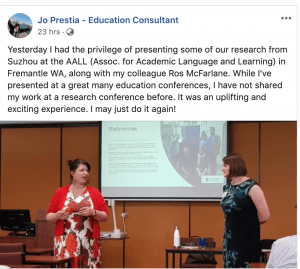
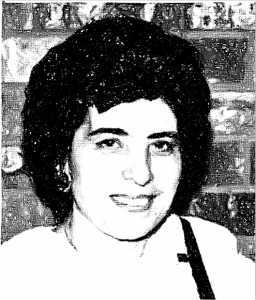
Ros and I presenting some of our Suzhou research at AALL

On reflection though, I think they might have some authentic overlaps. The first and foremost is a genuine commitment to student learning. The Association for Academic Language and Learning (AALL) Conference brings together a group of higher educationalists biennially to share research and understandings about international student cohorts. They come together to network and put faces to names seen only in journal articles and books. This year, in Fremantle, W.A., there were representatives from many universities and colleges who work with international students. The types of research I had the pleasure of hearing about over three full days are mind blowing to say the least. To have had the opportunity to present some of our research from our teaching experience in Suzhou, China earlier this year was a highlight.

Going through my copious notes recorded throughout the conference I have lifted out some of the things I heard that really resonated with me. I would love to hear your thoughts, please post below once you’ve had a chance to digest.

Interculturalism is a mindset. We need to be thinking about it all the time.” (Dr Janette Ryan)

“We all benefit from teaching international students.” (Athanassia Iosifidou)

“We become who we are by our interactions with others.” (Dr Maggie McAlinden)

Am I hallucinating my level of English?” (International doctoral student – ECU)

“Students don’t come with a deficit of language but a richness of language which we need to develop.” (Dr Jo McFarlane)

“We pay insufficient attention to their individualism. They all come from different countries but we bundle them in together as international students.” (Dr Pam Delly)

English is a language not a measure of intelligence.

“Champions of students” (Janette Ryan)

In her final address at the conference, Janette, described us as ‘Champions of students.’ For me this is not simply an uplifting comment but a call to action for all educators and parents. In fact it should be a moral obligation for everyone to be a champion to students – ALL students. Sure, teachers make a difference, we certainly do, but without students we are nothing. Be a champion to students – I dare you.

Thanks for reading 🙂

References

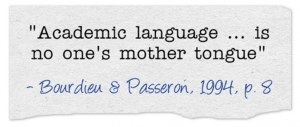
Bourdieu, P. and Passeron, J-C. (1994). Introduction: Language and the relationship to language in the teaching situation. In Bourdieu, P., Passeron, J-C. and de Saint Martin, M. (Eds) Academic Discourse (pp. 1-34). Cambridge: Polity Press.