Dear Parents/Guardians, Welcome to the VCE!

Welcome to VCE, the two most important years in the life of your child. In many ways I think it’s such a pity that they remain such a make or break part of an adolescent’s secondary education – but until attitudes change and the powers recognise that our children could be so much more if we were not all subjected to the same test, on the same day, at the same hour and all just to get a number which isn’t even out of a nice round number like say…100. No, the highest ATAR score any child can achieve is 99.95. All well and good. BUT this number or ranking has a massive lead into period, only to be valid for just a short time while universities get their acts together and make an offer. After that the rating is invalid – no one really ever asks again, do they? Then there are other students who work their way through an equivalent course so as to gain a VPC certificate. They don’t sit VCE exams and therefore do not gain an ATAR score. They go onto apprenticeships and/or TAFE courses. Some students add in VET combinations that can enhance both VCE and VCAL courses. A number of Victorian secondary schools also offer their students the BaccalaureateAll are invaluable experiences that I hope the students appreciate and take full advantage.

This is all great news but what I really want to focus on in this post is what you as parents or guardians can do to assist and support your children as they enter and complete their last two years of secondary education with an emphasis on VCE/VET certificates leading to an ATAR score.

Make an effort to eat dinner together as a family unit where possible. This will give you an opportunity to ask about their day but don’t just ask how their day was, be more precise. For example, ask them what they enjoyed about school today, what was their ‘ah ha’ moment, what challenged them, what surprised them.

Encourage them to share their learning with you. This can be done while you’re cooking or walking the dog. My eldest would read her essays aloud to me while I was preparing dinner. It helped her grasp her thinking and attend to any errors. I didn’t even have to say anything. If you think they could improve, ask them to tell you more about this or that – this will help them articulate their thinking and be more insightful.

You might like to read their English or Literature text so you can prompt them or at least know what they’re discussing in those essays.

If they are unsure, have questions, or don’t seem to grasp the concepts, encourage them to seek assistance from their teachers, if not that, remind them that there are other teachers who also teach the same subject. They might have someone else they trust.

Remind them that there is more to life than that ATAR score. The final years of secondary education should have balance. You’ve heard it all before, make sure they are getting enough sleep, eat well, interact with friends and family, do things they enjoy, watch a movie, go to dinner or a concert, work part-time – balance is key here.

Don’t pressure them, let them know you’re there, communicate, love, encourage and celebrate. Oh, and get them to write often, with a pen! You’ll thank me later!

All the best.

Thanks for reading 🙂

The power of Acrostic Poems

Letters

An acrostic poem is a composition where the first letter on each line spells out a related word or phrase. You are probably familiar with acrostic poems in relation to names using adjectives to describe the person. My kids sometimes compose them for me on special occasions such as Mothers’ Day,

aMazing

lOving

Tenacious

Happy

Extraordinary

Radiant
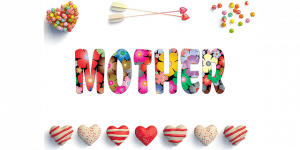
MOTHER

Acrostic poems can also be used as a learning tool. For example, let’s take the word LEARNING. Place each letter on a separate line;

L

E

A

R

N

I

N

G

Then, each letter becomes the first letter of your word or phrase to do with learning. Hence,

Literacy

Engaging

Academic

Reading

New experiences

Improvement

Numeracy

Grasp

An acrostic poem can also take other forms. Some allow the first letter to come anywhere along the word (as in MOTHER above) or line, for example, 

This school has improved the LITERACY skills of its students by exposing them to a wide range of age appropriate books.

While acceptable, I much rather the challenge of leaving the letter as the first of each word or phrase.

I enjoy challenging my students to compose more detailed acrostics although this task is easily differentiated to suit the learning needs of individual students, with a little added challenge.

I find they are a great way to introduce letters and words.

A is for APPLE… (remember all words must relate)

Apple juice

Peel

Pink ladies

Lunch

Eat

Challenge them to write or say whole sentences;

Apple juice tastes better when the

Peel is removed before juicing.

Pink ladies are my favourite fruit to eat for

Lunch, although I also like to

Eat granny smiths, but only in my grandma’s apple pie!

It can be quite a challenging task for older students, easily incorporated into the learning or used as a revision tool.

For example, last week’s topic in my Foundations class was Social Theories. Here’s one I prepared earlier (hehe)
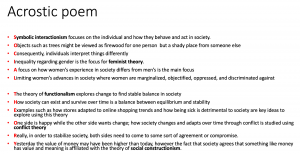
Acrostic Poem – Social Theory

Why not have a go yourself or challenge your students. Acrostics poems do not have to rhyme, but hey, that’s an added challenge if they’re up for it. The words and phrases can stand alone or create a running commentary. Be creative! I would love for you to share some of the compositions or ideas you come up with.

Thanks for reading 🙂 
 

So what if the beach was a whiteboard?

In today’s classrooms on at least one wall, there exists a whiteboard – used to be a blackboard but those days are long gone. I’m wondering then if maybe it’s almost time to sign off on whiteboards. Yes, I know we have those interactive numbers in many schools but even so…I’m not convinced they are being used to capacity.

Since it’s supposed to be summer in Melbourne – I say ‘supposed to be’, cause I’m currently at the beach in a lovely new house on holiday, just a few minutes walk from the beach, and it’s freezing… aside from that… what if the beach was a whiteboard? What might this look like?

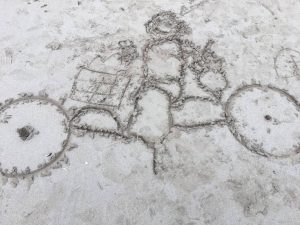
This post was initially prompted and began swirling in my head by a couple of photos sent to me in November when most kids were busy studying for upcoming exams. It was cemented in me last night when walking along the beach here and happening upon some wonderful sand drawings.

sand drawing

What prompts children (and adults) to write and draw in wet sand? Have you ever thought about it?

I bet you’ve done it.

Thomas was prompted to write in the sand while studying for his English exam. Yes, really. He scraped out quotes from his novel as a way to remember them. Funny. No one encouraged him to do it, in fact, he was on his own down at the beach and then…he picked up a stick.

He tells me he actually planned to walk down to the beach so he could write them in the sand.

Thomas’ sand quotes

Why?

“I didn’t have a whiteboard. I usually write them on a whiteboard, rub them out and write them again.” At the beach, he didn’t need to rub them out. It was expansive enough to just move on to another space and repeat.

Really?

Thomas purposefully adapted his preference for learning and used his immediate access to the sand in order to learn.

As he stands back to admire his writing, passers-by are curious.

“It’s okay,” says Thomas, “I’m just revising for my English exam.”

Clever.

Really?

Is that what it is?

Clever?

Thomas doesn’t think so – for him, he was just studying, thinking, adapting to his environment, taking advantage of what he had – a stick, a voglia, (desire) to explore learning, sand, prior knowledge and experience.

So what if the beach was a whiteboard?

How might you use it for learning?

Thanks for reading 🙂

Can’t you make it more interesting? To me it’s like I’ve heard it all before.

Yesterday I spent quite a while making a new infogram about what Year 12 students must do over the Term 1 holidays. Before I publish these types of things I always seek my daughter’s opinion on the points  – she being in Year 12 – I find it is very important that she thinks it is worthwhile putting it ‘out there’. Well last night I got a response that I was not expecting – you can read it in the post heading…

I must admit, I was offended. I did try to explain how important it was but to no avail, so I just shut down and watched some mindless TV prior to one of my favourites on a Wednesday night – I love “The Good Wife” – are you shocked?

parmiggiano sauceAnyhow, back to the point, I can be easily distracted, and am especially good at procrastinating with work although this tends to be an advantage for my family as I mostly procrastinate and avoid ‘work’ by cooking. BTW I have already prepared a Calabrian parmiggiano sauce for tonight’s dinner!

Fight it – back to topic at hand. So now after I’ve had a chance to think I’d like to propose 7 ‘interesting’ points that I hope will inspire Year 12s and in fact any student to ponder during the term break.

You’re tired. Tired of early wake ups, tired of trudging your way to school, tired of attending and listening to blablablabla lots of work to do, blablabla here’s the homework, blablabla SAC coming up next week, blablabla in preparation for SACs you need to … blablabla. Tired of coming home to do more work, prepare study notes, watch this video, read that text, complete these exercises, study, study, study. Am I warm? Okay then, why not take a break? Yes I know, your teachers have said that you need to do at least 10 hours of work over the holidays – and for Year 12s that’s for EACH subject! So that means 50 hours of homework /study, over 10 days, not counting the weekends, that’s 5 hours a day on average. So let’s break that down:

  1. 10 days = 240 hours (not counting 3 weekends x 2 days in each = 6 days, 144 hours free).
  2. 24 hours in a day minus 5 hours of homework / study = 19 hours free
  3. 19 hours free, let’s say, 10 hours sleep = 9 hours per day free
  4. 9 hours a day for 10 days = 90 hours free
  5. 90 hours over 10 days to work, travel, socialise or just lounge around, finally…
  6. 144 hours (weekends) minus 40 hours (per day) average sleep time (or less cause you are too busy raging) + 90 hours (week days) over two weeks = 194 hours free over the term break – and yes it does include lunch at Nonna’s house on Easter Sunday BUT the Easter Monday public holiday makes up for it, so no complaints!
  7. If we do the calculations for time over the last term, that is 10 weeks of school (50 days, actually less due to staggered start times, and a public holiday or two) but essentially 50 days x 24 hours = 1200 hrs. School’s in for 7 hours (8:30am-3:30pm) a day for 50 days = 350 hours, Year 12s should be doing at least 3 hours of homework / study a night, 3 x 50 = 150 hours. Calculating an average of 8 hours sleep per night over 50 days = 400 hours. That means 1200 minus 350, minus 150, minus 400 = 300 hours free, not including weekends over the 50 weeks. So you only had 300 hours during weekdays over 50 weeks of the term BUT you get 194 hours free over two weeks during term break. Get the picture?

Okay, was that a bit more interesting, something you haven’t heard before?

Good! Now … let me spell out your 6 MUST DOs for the holidays…that is… if you WANT to do well in VCE / HSC at the end of the year. If not, well enjoy your holidays but don’t blame the system if you don’t achieve your best, whatever that might be + effort = satisfaction. Dreams + No / little effort = Disappointment. I’ll let you choose…

Here’s the infogram I prepared yesterday
6Mustdosovertheholidays title=
easel.ly

You can’t teach what you don’t know

NeurotransmitterWelcome 🙂

Let’s learn a few things about the Logic of English

Did you know…?

  • English words DO NOT end in i, u, v or j

That’s why ‘boy’ is spelt b-oy and not as the sound suggests b-oi

  • C softens to an ‘s’ sound after e, i and y, otherwise we say ‘k’

think about it in terms of the word ‘circus’

  • a, e, o, u usually say their names at the end of syllables 

think paper, pa  – per

we use double letters to shorten sounds in syllables, for example, sound out pepper, pep – per, otherwise we would pronounce it ‘peper’ pe – per

  • one of the most misspelt words is ‘miscellaneous’

now let’s think about it as we apply the rules above;

mis  cel  la  ne  ous

mis (all good) cel (why is it an ‘s’ sound? because of the ‘e’) la (a says its name at the end of a syllable) ne (e also says its name at the end of a syllable) ous (ou is a phonogram, both letters together make this sound). Does that make more sense now?

Cool, right?

Want to know more?

Watch this Logic of English video

Do we teach this to our students? Could we? Would it make a difference to our understanding and development of reading and writing and would it improve spelling? Let me know what you think, click below and leave a reply.

Thanks for reading 🙂